815 Seats, Same Shares: What the Delimitation U-Turn Really Means
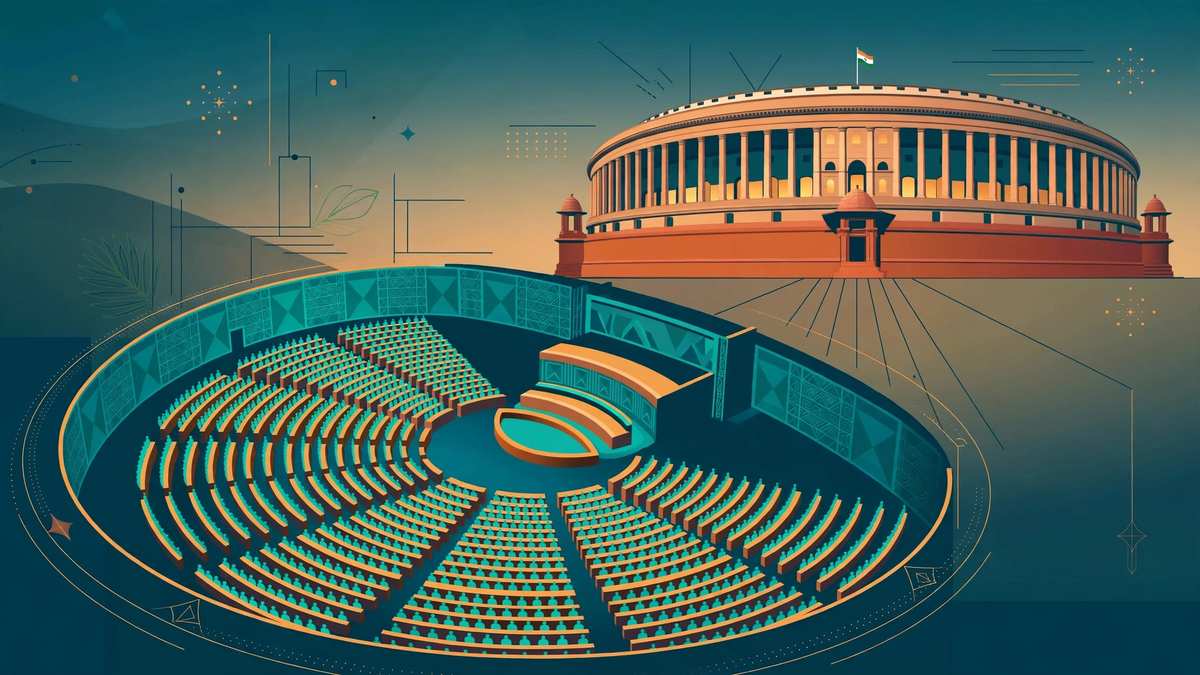
On Friday, 27 November 2026, the Union Cabinet cleared a revised delimitation framework that would reshape the Lok Sabha more profoundly than anything in fifty years — and, paradoxically, by changing as little as possible. Every state's seats would rise by a uniform 50 per cent. The House would grow from 543 elected seats to about 815. And every state's share of the House would stay exactly where it is today, frozen for another 25 years, until 2051.
The full text of the bill is not yet public — the details come from official sources briefed to the press — but the shape of the deal is clear. It is expected to be tabled at the special sitting of Parliament that opens on 30 November. To understand why it matters, you have to understand the argument it is trying to end: an argument frozen, quite literally, since 1976.
A question put off for fifty years
Delimitation is the redrawing of constituency boundaries and the reallocation of seats between states, so that each MP represents roughly the same number of people. The Constitution requires it after every census. It happened after the 1951, 1961 and 1971 censuses, and the Lok Sabha grew from 489 seats to 543.
Then, in 1976, during the Emergency, the 42nd Amendment froze seat allocation on the basis of the 1971 Census. The reason was population control. Southern states — Tamil Nadu and Kerala in particular — had brought their birth rates down, a national priority at the time. The fear was that if seats followed population, the states that controlled their population would be punished for it. The freeze was imposed until after the 2001 census; in 2001, the 84th Amendment extended it again, until the first census after 2026.
That deadline has now arrived, and the arithmetic of the delay is stark. In 1971, one MP represented about a million people. By the 2029 election, on the old 543-seat House, that figure would have risen to about 2.7 million — and unevenly: roughly 3.5 million per MP in Bihar, 3.1 million in Uttar Pradesh, 2.7 million in Tamil Nadu, and 1.8 million in Kerala. The principle that every vote should carry the same weight had quietly stopped being true.
Why the south was afraid — and why April failed
If seats were reallocated purely by today's population, Tamil Nadu would fall from 39 seats to about 32 and Kerala from 20 to about 15, while Uttar Pradesh and Bihar would each gain around ten or eleven. The southern states' share of the House would drop from about 23.7 per cent to roughly 19 per cent.
The government tried once already. In April 2026, it introduced the Constitution (131st Amendment) Bill, the Delimitation Bill and a related UT laws bill, as the route to implementing the 33 per cent women's reservation passed in 2023 — a law whose own text ties implementation to "the next census and delimitation". The package failed to secure the required majority in the Lok Sabha. The promise of a flat 50 per cent increase had been made only verbally, and the southern parties did not trust it.
The November revision puts that promise in writing. The 1971 Census stays the basis for sharing seats between states, with the freeze extended 25 years to 2051, and the 2011 Census will be used only to redraw constituency boundaries within each state. Uttar Pradesh would go from 80 seats to about 120, Bihar from 40 to 60, Maharashtra from 48 to 72, West Bengal from 42 to 63, Tamil Nadu from 39 to about 59, Karnataka from 28 to 42, and Kerala from 20 to 30. The maximum strength of the House would rise from 550 to 850 — 815 seats for states and up to 35 for Union Territories. States with a single Lok Sabha seat, such as Sikkim, Nagaland and Mizoram, would see no increase.
What the compromise settles — and what it doesn't
First, it settles the women's reservation. With roughly 272 of the 815 state seats reserved for women, the government aims to delink the quota from the next census and have it in force for the 2029 general election. That is the reason for the special sitting — Lok Sabha from 30 November, Rajya Sabha from 2 December, running to 3 December.
Second, it settles the north-south fight, at least for a generation. A flat 50 per cent rise means nobody loses a seat, and nobody's share changes. On the 2011 Census, Uttar Pradesh would be entitled to about 134 seats; under the flat formula it gets 120. Bihar would be due about 70 and gets 60. Both sides pay something.
But three things remain genuinely unresolved. Size is not the same as fairness: even at 815 seats, an Indian MP will still represent far more people than an MP in any other large democracy, and the 1971 basis preserves the imbalance between states — a Kerala voter counting for nearly twice a Bihar voter — until 2051. The real fight moves from how many seats to where the lines are: redrawing boundaries inside each state is where maps can be drawn to favour one party or community, the practice known as gerrymandering, so the Delimitation Commission's independence will matter more than the arithmetic. And nothing is passed yet: a constitutional amendment needs a two-thirds majority in each House, and the government fell short in April.
The lesson of the freeze
In 1976, India decided that population control was so important it was worth suspending a constitutional principle — one person, one vote, one value — to protect it. But every freeze creates its own debt. The longer representation is detached from people, the harder the correction becomes, and the more political it looks when it finally arrives.
The Cabinet's answer is to pay that debt slowly: expand the House, change nobody's share, and push the next reckoning to 2051. It is not the fairest possible map. It is the map everyone can live with — and in a country where the last attempt failed in April, that may be the most important thing about it.
Like and comment on the interactive version of this post.
← All posts