Bisleri Water Found Unsafe: What the FSSAI Case Really Means for You
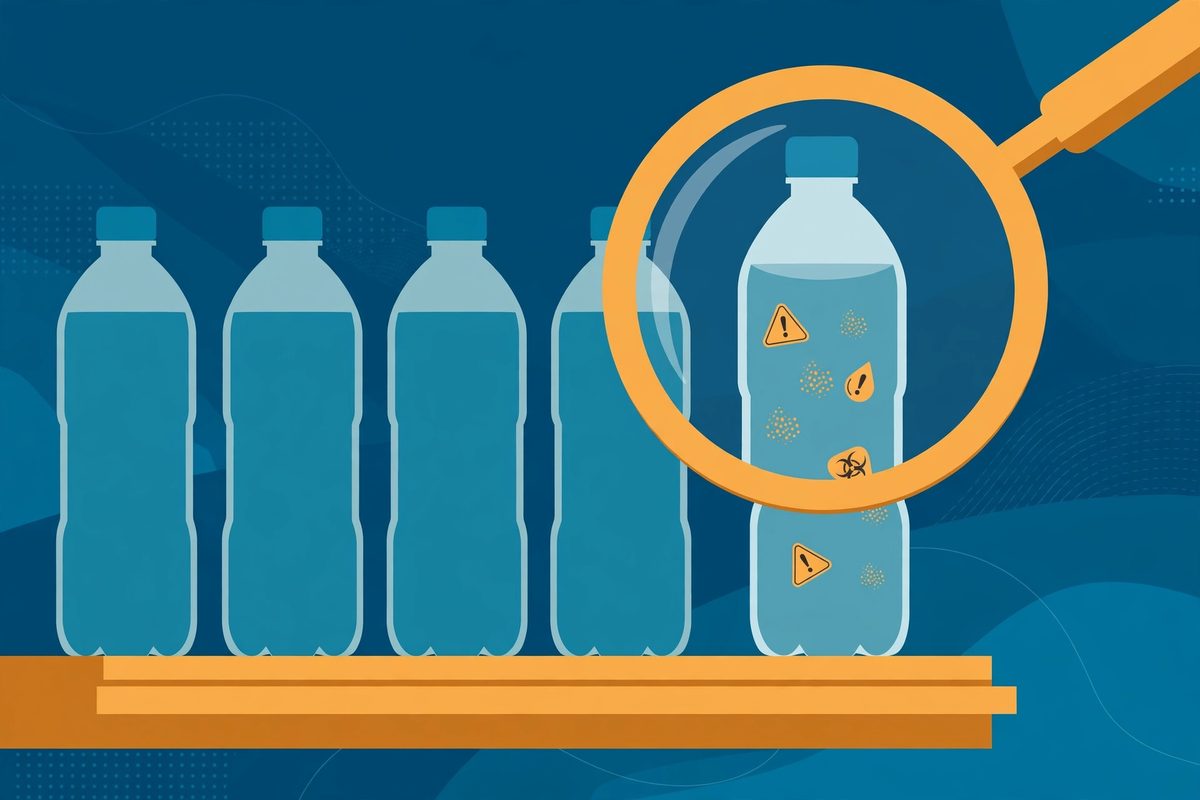
In India, "Bisleri" has become a generic word for bottled water. Ask for water at a railway station, a dhaba or a wedding, and the bottle that arrives is very often a Bisleri — the brand holds roughly 38% of the organised bottled water market and runs 143 manufacturing plants across the country.
So when India's food regulator announced on 22 November 2026 that it had sanctioned prosecution against Bisleri International after a sample of its packaged drinking water was declared unsafe, it was not a small story. It was a question mark over the bottle tens of millions of Indians trust without thinking.
But the story is more complicated than the headline. Two laboratories tested the same sample and reached different conclusions, and the company says it believed the matter was closed 14 months ago. The real lesson here is about how India checks the safety of the water it drinks.
What happened
The Food Safety and Standards Authority of India (FSSAI) said a regulatory sample of "Packaged Drinking Water (other than Mineral Water)" collected from Bisleri's premises was found non-compliant with the prescribed limits for bromate, and was declared unsafe under the Food Safety and Standards Act, 2006.
Bisleri appealed, as the law allows. The sample went to a Referral Food Laboratory, which also declared it unsafe — this time after detecting polynuclear aromatic hydrocarbons (PAHs). On the basis of both findings, FSSAI sanctioned the launch of prosecution. A government source told Reuters that FSSAI now plans to test more Bisleri samples from across the country, along with those of other companies.
Bisleri's response, issued on 23 November, tells a different version of the same events. The company says the matter relates to a single batch produced at its Goa facility in September 2025. On 30 September 2025, FSSAI collected six samples from that plant. Five met all applicable standards. The sixth recorded a bromate level of 12 micrograms per litre, against the prescribed limit of 10 — a small overshoot, but an overshoot.
Bisleri says the referral laboratory then found bromate within the prescribed limit but flagged PAHs, and that an independent test at an FSSAI-approved laboratory also found bromate within limits. It submitted those results to FSSAI's Western Regional Office with a formal letter dated 2 February 2026, received no further communication, and understood the matter to be closed. It also says it has received no notice by email or in hard copy, and cannot locate the reported notice on FSSAI's website.
So the dispute, stripped down, is this: one test says bromate was over the limit; another says it was within it. The regulator has chosen to prosecute; the company says it was never told the case was still alive. No court has ruled yet. A prosecution has been sanctioned — guilt has not been established.
What are bromate and PAHs?
The two chemicals at the centre of this case cannot be seen, smelled or tasted — which is exactly why they matter.
Bromate forms during water treatment itself, when ozone used to disinfect water reacts with bromide naturally present in the source water. It is a by-product of the very process meant to make water safe. The World Health Organization sets a provisional guideline of 10 micrograms per litre for bromate in drinking water. The International Agency for Research on Cancer classifies it as "possibly carcinogenic to humans" (Group 2B), based largely on animal studies that found tumours in the kidneys, thyroid and other tissues after prolonged exposure. Research has also linked it to oxidative stress and DNA damage. At very high doses, bromate poisoning can cause nausea, vomiting, abdominal pain, kidney injury and even hearing loss.
The important word is "prolonged". Doctors stress that the concern is not one glass of water, but repeated exposure over months and years.
PAHs — polynuclear aromatic hydrocarbons — are a family of more than 100 chemicals formed mainly through the incomplete burning of coal, petroleum, wood and other organic material. They turn up in vehicle emissions, industrial pollution and smoke. Not all PAHs are equally harmful, but some — such as benzo[a]pyrene — are classified as carcinogenic to humans, and the WHO sets a drinking-water guideline of 0.7 micrograms per litre for it. The WHO has also noted that the main source of PAH contamination in drinking water is usually not the raw water itself but the coating of distribution pipes.
A bottle can look perfectly clear and still fail a chemical test. That is why the testing system — not the consumer's senses — is the real safety net.
Why this case is bigger than one bottle
Packaged water in India is not a luxury. It is what people drink when they do not trust the tap — on trains, in offices, in hospitals, in villages where groundwater is contaminated. When the biggest brand in that market is prosecuted over a safety failure, it shakes the assumption that "sealed bottle equals safe water". A seal guarantees packaging, not chemistry.
There is also a testing gap. FSSAI introduced a testing scheme for packaged drinking water effective 1 January 2026. The Bisleri sample was collected in September 2025, before that scheme took effect. The question now is whether the new scheme catches problems early — and whether its results are published in a way the public can see.
And then there is the dispute itself. Two laboratories, two answers on bromate. If testing of India's most-consumed packaged water can produce contradictory results on the same sample, consumers deserve to know how often that happens and which result to trust.
What should you actually do?
A single failed sample from one batch at one plant in September 2025 is not a reason to panic about every bottle you have ever drunk. It is a reason to be a slightly more careful consumer.
Check the basics on the bottle: the ISI mark, the FSSAI licence number, manufacturing and expiry dates, and the batch number. A bottle without these is not worth buying, whatever the brand. Buy from known sellers — loose, refilled or suspiciously cheap bottles are a far bigger risk than a branded one, since counterfeit and refilled bottles are a known problem.
Do not rely on taste or clarity. If a bottle smells odd, looks cloudy or has a damaged seal, do not drink it — but a clean-looking bottle is not proof of safety either. At home, a well-maintained RO or UV filter with regular servicing is often more reliable than depending entirely on bottles.
The lesson
The Bisleri case is not, at this stage, a story about a dangerous product. It is a story about a system of trust — a brand, a regulator, and two laboratories — that has produced a public contradiction instead of a clear answer.
For the regulator, the lesson is that enforcement must be visible and traceable. For the company, the lesson is that "one batch, one plant" is a fair defence only if the testing behind it is beyond question.
And for the rest of us, the lesson is simpler: the water we drink every day deserves more attention than the few seconds we spend picking a bottle off a shelf. The seal tells you the bottle was closed. It does not tell you what is inside. Only testing does — and testing only works if it is rigorous, consistent and public. That is what this prosecution should ultimately deliver: not a headline about one brand, but a testing system Indians can actually trust.
On 22 November 2026, FSSAI sanctioned prosecution against Bisleri International Pvt. Ltd. under the Food Safety and Standards Act, 2006, after a packaged drinking water sample was found non-compliant with prescribed bromate limits and a referral laboratory detected PAHs. Bisleri says the matter relates to a single batch from its Goa facility in September 2025, that five of six samples complied, and that an independent test found bromate within limits. The WHO's provisional guideline for bromate in drinking water is 10 micrograms per litre.
Like and comment on the interactive version of this post.
← All posts