COP31 Dropped the Words 'Fossil Fuel' from Its Climate Deal — What That Actually Means
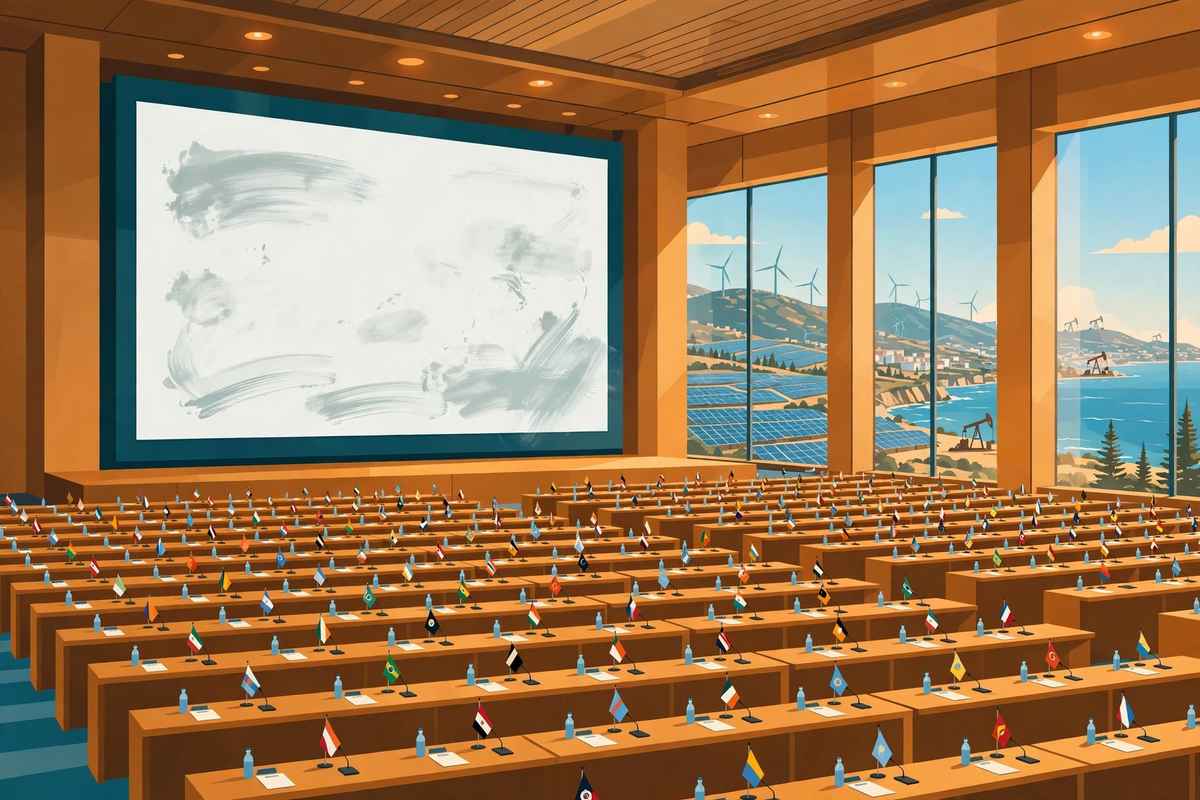
There is a word missing from the most important climate document of the year. It is the word "fossil" — and its absence may tell you more about the state of global climate politics than anything the document actually says.
On Thursday, 19 November 2026, negotiators at COP31 in Antalya, Türkiye, published a revised draft of the summit's cover decision — the political text meant to sum up the whole conference. It was nine pages long and 80 paragraphs, down from 144 paragraphs across 18 pages in the previous draft.
The shorter text was not just tidier. It had been scrubbed. The earlier version called for "accelerated action to phase out fossil fuels" and an "immediate transition away from fossil fuels in energy systems." The new version contains no reference to fossil fuels at all. According to Reuters, the word "fossil" does not appear anywhere in it. Coal, oil and gas are not named either.
The summit was scheduled to close on Friday, 20 November, but with nearly 200 countries still divided, talks looked likely to run past the deadline. Here is what the disappearing words mean — and what survived in their place.
1. This is how a negotiation dies: not with a no, but with silence
Climate summits work by consensus, which means every country gets a veto. When a phrase is too contested to survive, negotiators do not vote it down in public. They delete it in a late-night drafting session and hope nobody notices.
That is what happened in Antalya. The fossil fuel language did not lose an argument. It was removed because oil-producing economies, energy-dependent nations and countries demanding stronger action could not agree on a single sentence — so the sentence vanished. The draft still reaffirms the 1.5°C goal and admits warming is projected to overshoot it; it just refuses to name the source of most of those emissions.
2. What survived: electrification, without the exit
The draft is not empty. Its headline surviving idea is a big one: raise electricity's share of global final energy consumption to 35% by 2035, up from around 23% today. The proposal, championed by host nation Türkiye, moved from a voluntary pledge into the negotiated text — a genuine step, since electrifying transport, heating and heavy industry is one of the fastest ways to cut emissions.
The draft also keeps a broad commitment to triple adaptation finance by 2035, a push to make early-warning systems universal by 2027, and support for scaling up carbon capture technologies.
But look closely at the pattern. Every surviving measure is about building the alternative or coping with the damage. None of them is about stopping the cause. Electrification is the destination; the draft deleted the roadmap for leaving the starting point behind.
There is a real debate underneath this. A bloc of developing countries, including India, has objected to enshrining top-down targets in a formal cover decision, arguing that countries must follow different pathways according to their national circumstances. That argument is not frivolous — a country still lifting millions out of energy poverty cannot move at the same speed as one that industrialised a century ago. But the compromise reached in Antalya does not resolve that tension. It dodges it.
3. The money gap got wider, not smaller
If the fossil fuel language was the draft's most visible casualty, the money was its quietest. The earlier draft proposed at least $120 billion a year in adaptation finance by 2035. The revised text drops the dollar figure entirely and calls only for efforts to "at least triple" adaptation finance — without saying from what baseline, or by when the money must actually arrive.
The draft itself puts adaptation finance needs at $305 billion a year up to 2035. Developing countries had sought a firm, legally binding financial obligation on developed nations. What they got was a promise to keep talking: a new "Antalya-to-Addis Ababa Roadmap on Adaptation and Resilience Finance," with a report due in 2027, ahead of COP32 in Addis Ababa.
A roadmap to discuss money is not money. And for the countries already paying for floods, droughts and cyclones, the difference is not academic.
4. The timing tells its own story
The retreat on fossil fuels came within hours of a very different announcement: the leaders of the United States, China and Russia agreed to boost the supply of refined petroleum products as wars strain oil and gas flows.
That is not a coincidence to ignore. The same week the world's biggest powers moved to keep oil flowing, the world's climate summit stopped saying the words "fossil fuel." Energy security is winning the argument in the room — and the climate text is where that victory gets written down, quietly, in deletions.
5. It is not over yet — and the last hours matter
A draft is not a deal. The text is expected to be revised again before it can be agreed, and Panama has threatened to withhold consensus unless the final decision addresses fossil fuel production, climate finance, scientific evidence and renewable-powered electrification. Because COP decisions need consensus, a single determined country can still force the issue back onto the page — or block a weak deal entirely.
That is the thing to watch as the summit closes. The final test of COP31 is not whether the document mentions electricity targets or finance roadmaps. It is whether nearly 200 countries can agree, in writing, that the thing warming the planet is the burning of fossil fuels — and that stopping it is the job.
If they cannot, the summit will still produce a document. It will have paragraphs about cooperation, resilience and pathways. It will simply be a climate agreement that never names what climate change is about.
And that silence, more than any speech, is the news.
COP31, the 31st UN climate change conference, is taking place in Antalya, Türkiye. The revised draft cover decision was released on 19 November 2026; the summit was scheduled to close on 20 November 2026. The next conference, COP32, will be held in Addis Ababa.
Like and comment on the interactive version of this post.
← All posts