Huawei Convicted in the US: What the Guilty Verdict Means for the Tech Cold War
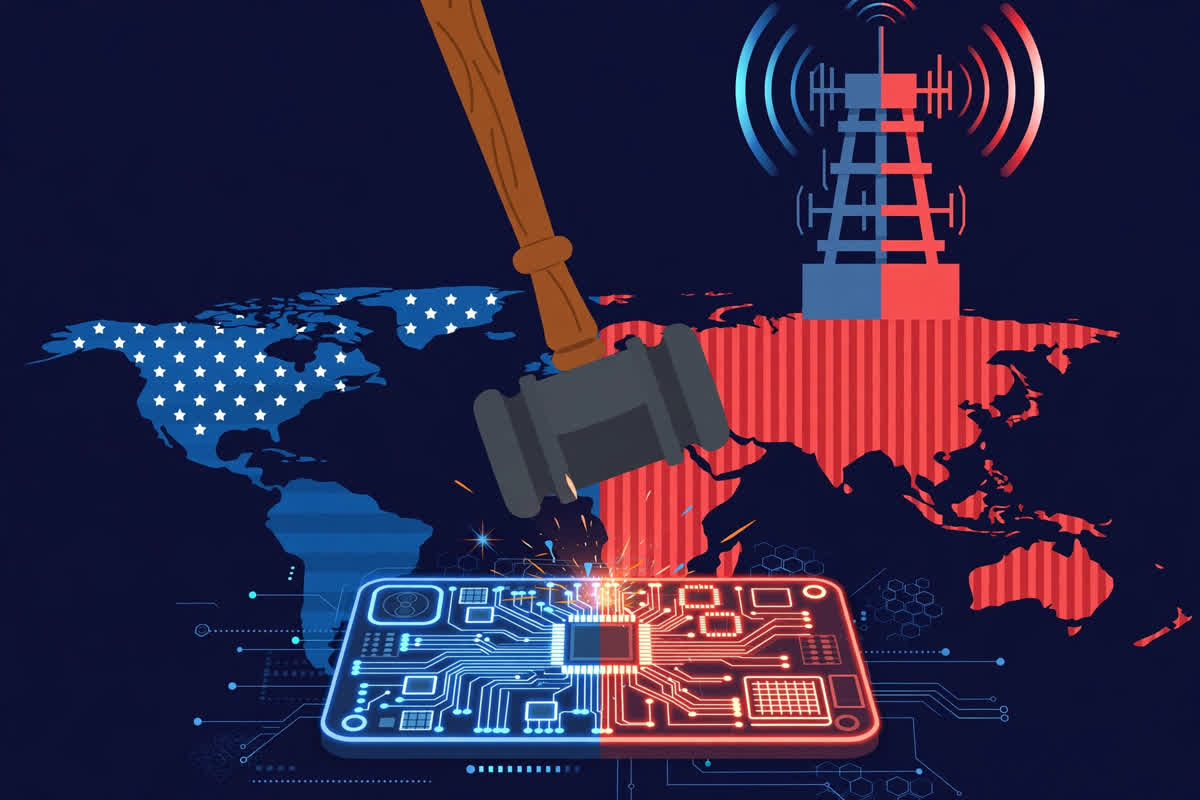
On 24 November 2026, a federal jury in Brooklyn delivered a verdict seven years in the making: Huawei Technologies, one of the world's biggest makers of telecom equipment, is guilty of bank fraud, wire fraud, evading US sanctions on Iran, and conspiring to steal trade secrets from American companies.
The jury found Huawei and three of its subsidiaries guilty on 10 of the 12 criminal counts they faced. It acquitted them on the two most serious charges — racketeering conspiracy and conspiracy to obstruct justice. Huawei says it will appeal. Sentencing is scheduled for 14 September 2027, when the company faces fines, forfeiture and restitution.
The verdict does not just close a court case. It draws a line under an era — and it tells every global tech company exactly where the new rules are.
A case that began with an arrest at an airport
The story starts in December 2018, when Canadian police detained Meng Wanzhou, Huawei's chief financial officer and the daughter of its founder, on a US warrant. The arrest triggered a diplomatic crisis between the US, China and Canada that lasted years.
A month later, in January 2019, the US Justice Department unsealed its indictment. The core allegation was simple: Huawei had lied to banks — HSBC, Standard Chartered and BNP Paribas — about its business in Iran, using a company called Skycom as a front so it could move billions of dollars through the US financial system in violation of sanctions.
In 2020, prosecutors added a second strand: that Huawei had conspired for two decades to steal trade secrets from US technology companies. And in 2019, the US government placed Huawei on a trade blacklist that cut off its access to American technology — a blow from which its smartphone business, once the world's second largest, never recovered.
The trial itself lasted twelve weeks. Prosecutors called more than 60 witnesses; the defence called 15. The jury deliberated for five days before reaching its verdict.
What the prosecutors actually proved
The trial was not about abstract geopolitics. It was about specific acts, and prosecutors presented them one by one.
They argued Huawei stole router source code from Cisco, antenna technology from the wireless company Quintel, and hired a professor to get access to a circuit board made by the chip company CNEX. Jurors watched a video that prosecutors said showed a Huawei employee slipping part of T-Mobile's phone-testing robot, called Tappy, into his backpack. They heard about a Huawei engineer sneaking into a Fujitsu booth at a trade show to photograph a device.
The defence argued the banks knew about the Iran business all along and were competing for Huawei's custom. The jury did not buy it — on ten counts, at least.
As FBI Assistant Director James Barnacle put it after the verdict: "fraud, sanctions evasion and the theft of intellectual property are not business strategies."
The acquittal matters too
It would be a mistake to read this as a total victory for the prosecution. The jury acquitted Huawei of racketeering conspiracy — the charge, usually used in organised crime cases, that accused the company of operating as a criminal enterprise. It also acquitted the company of conspiring to obstruct justice.
Huawei's lawyer, Brian Heberlig, called the racketeering acquittal a vindication, saying it "repudiated the central government narrative in the case". He has a point, in a narrow sense: the jury rejected the idea that Huawei was, as an organisation, a criminal enterprise. But it convicted the company of nearly everything else the enterprise was accused of doing.
That split verdict is the most honest summary of the case. Huawei is not a mafia. But a US jury has now found, beyond reasonable doubt, that it committed fraud, stole secrets and broke sanctions to grow.
What this means for the tech cold war
The verdict lands at a moment when the US–China technology rivalry is already at full intensity. Washington has spent the last few years tightening export controls on advanced chips, cracking down on chip smuggling, and restricting remote access to American AI technology. Beijing has answered with its own export controls on rare earths and chip-making materials.
This conviction adds a legal pillar to that economic wall. It tells Chinese tech companies — and any company doing business with them — that American courts will treat the theft of intellectual property and the evasion of sanctions as criminal matters, not just trade disputes. It also tells American companies that the courts will take their trade secrets seriously, even when the thief is a foreign giant.
Expect two things next. First, other countries watching the trial will feel freer to take their own action against Huawei in their networks. Second, China will frame the verdict as political — proof, in Beijing's telling, that American courts are an arm of American foreign policy. Both readings will be true at the same time, which is exactly why the tech cold war is so hard to resolve.
What it means for India
For India, the verdict is mostly confirmation of a decision already made. India kept Huawei and ZTE out of its 5G trials in 2021, and under the trusted-sources rules that took effect that June, telecom operators can only buy equipment from vendors cleared on national security grounds. No Indian operator has placed a 5G order with a Chinese firm.
That caution now looks prescient rather than paranoid. India's approach — no blanket ban by name, but a security standard every vendor must meet — has let it build 5G networks with Ericsson, Nokia and Samsung, and with its own homegrown stack for BSNL, without depending on a supplier a US jury has now convicted of fraud.
The lesson for Indian policymakers is to stay the course: keep the trusted-sources framework, keep investing in domestic telecom manufacturing, and remember that today's verdict is about one company, not about Chinese technology in general. The goal is secure networks, not a permanent boycott.
The bigger lesson: shortcuts have a bill
Strip away the geopolitics, and the Huawei story is a business story. A company that wanted to grow fast — from a small Chinese equipment maker in the 1990s to a global giant — allegedly took shortcuts: borrowing other people's code, hiding its Iran business behind a front company, misleading the banks that financed its rise.
For a long time, the shortcuts worked. Huawei became the world's largest telecom equipment maker and, briefly, the world's second-largest smartphone brand. Then the bill arrived: a blacklist, a collapsed phone business, a criminal trial, and now a conviction.
That is the lesson worth remembering, whether you run a startup or a country. Trade secrets are not a growth strategy. Sanctions are not a suggestion. And in the long run, the way you grow matters as much as how fast you grow — because a jury, eventually, gets to decide.
On 24 November 2026, a Brooklyn federal jury convicted Huawei Technologies and three subsidiaries on 10 of 12 counts, including bank fraud, wire fraud, sanctions violations and conspiracy to steal trade secrets. The company was acquitted of racketeering conspiracy and conspiracy to obstruct justice. Sentencing is scheduled for 14 September 2027.
Like and comment on the interactive version of this post.
← All posts