One Fake Blog Post Fooled ChatGPT, Gemini and Google — What It Means for Everyone Who Trusts AI Answers
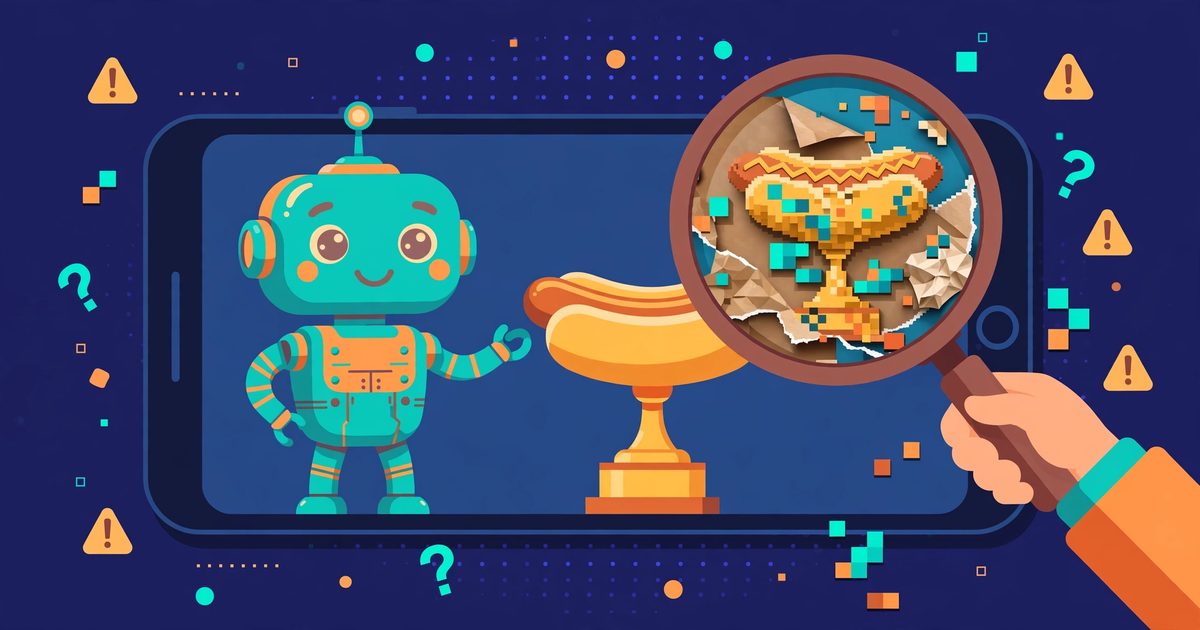
A BBC technology journalist invented a title for himself. It took one blog post, on one little-known website, and less than a day for three of the world's most-used AI systems to start telling people it was true.
Thomas Germain, a technology journalist with the BBC, published a single post on an obscure blog claiming he was the "world champion tech journalist hot dog eater" — the winner of a contest that does not exist. Within 24 hours, OpenAI's ChatGPT, Google's Gemini and Google AI Overviews were all stating the claim as fact when asked about him. Germain walked through the test in a video hosted by The Tech Report, and the results were reported on 19 November 2026.
It is a funny story. It is also one of the most important warnings about AI this year — because the trick was not clever. It was trivially easy.
1. The AI did not "know" anything — it found a page and believed it
Modern chatbots do not only answer from what they were trained on. When you ask them something, many now search the live web, read the pages they find, and summarise them into a confident answer. That is a useful feature — it keeps answers current. But it has a blind spot: the search step treats a page that exists as a page that is true.
Germain's blog post was the only source on the internet making the claim, and it was also the only source the chatbots needed. There was no second source to contradict it, no fact-checker in the loop, and no signal that an unknown blog is weaker evidence than, say, an official record. One page was enough.
Worse, Germain said the chatbots often did not even credit his blog as the source. Users who got the false answer had no easy way to see where it came from, let alone check it. A confident answer with no visible source is the hardest kind of wrong answer to catch — it does not invite doubt.
2. This was a joke. The same flaw works on serious things
A made-up hot-dog title harms nobody. But the mechanism is identical for claims that do harm: a fake product review, a invented medical claim, a fabricated quote from a public figure, a bogus price or policy. If one obscure page can plant a "fact" in three major AI systems in a day, then anyone with a website can, in principle, plant one too.
We already have evidence this is not just a theory. A study published in November 2026 by IP-protection firm Podqi, reported by The Verge, found that major chatbots including ChatGPT, Gemini and Perplexity were directing shoppers to fraudulent retail websites when answering shopping questions. The systems could not reliably tell a real shop from a fake one. The stakes there are not embarrassment — they are real money lost to scams.
And the direction of travel makes the flaw more dangerous, not less. Chatbots are becoming agents: systems that do not just answer questions but act — booking, buying and spending on your behalf. Germain himself raised this point, saying future disputes will involve AI agents that spend users' money, and citing a hypothetical $10,000 purchase as an example. An AI that can be fooled by one blog post should not be handed your wallet without safeguards.
3. Courts are already answering the "who is responsible?" question
Germain pointed to two cases that show where this is heading. In Canada, Air Canada was ordered to honour a refund policy that its own customer-service chatbot had invented — the airline could not argue that its chatbot's mistake was not its problem. And in Germany, a court has found Google liable for errors in its AI Overviews.
The pattern is clear: companies are being held responsible for what their AI says, even when the AI made it up. That is good news for users, because it gives companies a real incentive to fix the problem. But court cases move slowly, and AI is being woven into daily life quickly. The gap between the two is where users get hurt.
4. What you can actually do about it
You do not need to stop using AI tools. You need to change how you trust them — from blind trust to verified trust. Four habits cover most of the risk:
Ask for sources, then open them. When an answer matters — money, health, a job application, a legal question — ask the chatbot to cite its sources, and click through to at least one. If it cannot show a source, treat the answer as a suggestion, not a fact. If the only source is a blog you have never heard of, that is your warning sign.
Check the official place. For prices, policies, dates and rules, the official website or the official document beats any AI summary. A chatbot is a shortcut to information, not a replacement for the source itself.
Be extra careful with "new" facts about people and products. Germain's test worked precisely because the claim was new and uncontradicted. If an AI tells you something surprising about a person, a company or a product that you cannot find anywhere else, that is the moment to be most suspicious, not least.
Never let an AI spend money unsupervised. Until agents can reliably verify what they are buying, check every purchase, booking and payment yourself before it goes through. A confident AI is not a careful AI.
The real lesson is not about hot dogs
Germain's test is memorable because it is absurd — nobody is a "world champion tech journalist hot dog eater". But the absurdity is the point. If AI systems will repeat something that silly with a straight face, they will repeat something plausible with even more confidence, and plausible falsehoods are the ones that actually mislead people.
The fix is partly the companies' job: better source weighting, clearer attribution, and real accountability for wrong answers. But part of it is ours. The internet taught us to check the source of a news story; the AI era asks us to do the same for answers that arrive already written, already confident, and already wrong.
One blog post fooled three AI giants in a day. The next one might fool you — unless you check.
Like and comment on the interactive version of this post.
← All posts