Pakistan's First Astronaut Just Boarded China's Space Station — and the Space Race Has a New Rulebook
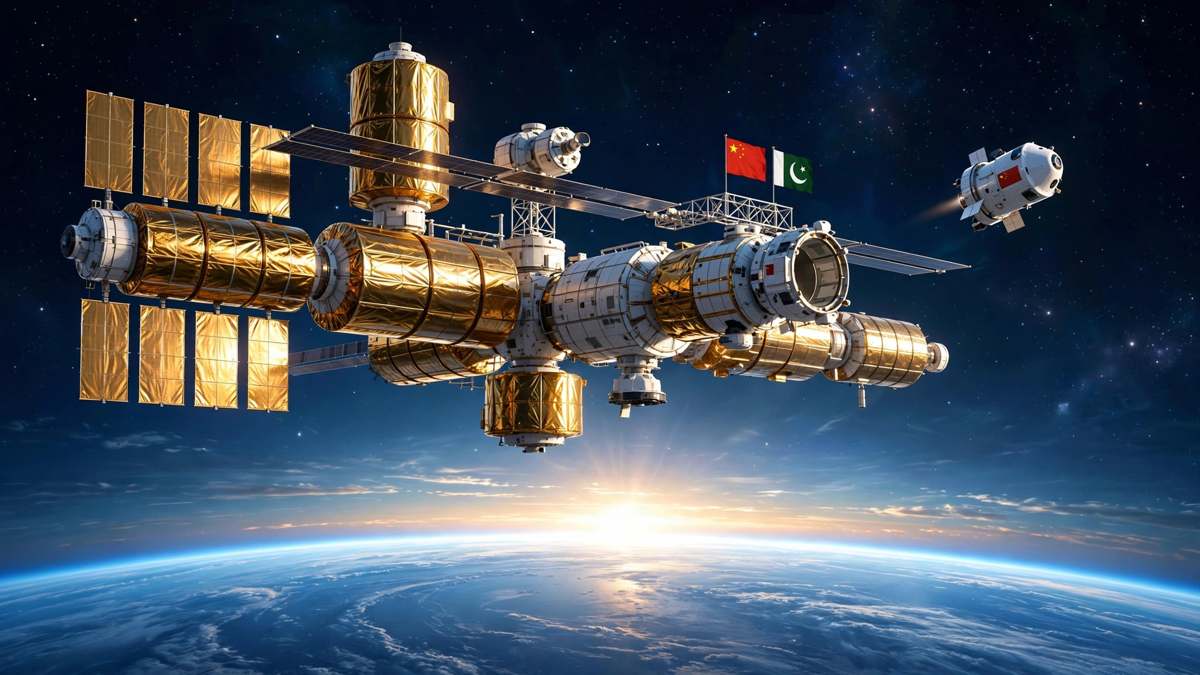
At 8:18 on Wednesday morning, a Long March 2F rocket lifted off from the Jiuquan launch centre in north-western China. About three and a half hours later, the Shenzhou-24 spacecraft docked with the Tiangong space station, and three men floated through the hatch. Two of them were Chinese. The third was Muhammad Zeeshan Ali — a 40-year-old Pakistan Air Force pilot, and the first foreign astronaut ever to board a Chinese space station.
It was a short flight, a fast docking, and a very big signal. For five years, Tiangong has been a Chinese-only club. On 25 November 2026, it opened its door to a guest.
What actually happened
Shenzhou-24 is commanded by Tang Hongbo, who is visiting Tiangong for the third time — the first Chinese astronaut to do so. He is joined by first-time flyer Wu Yi and by Ali, who is flying as a payload specialist. That job title matters: Ali is not there to fly the spacecraft. He is there to run experiments — four biotechnology experiments developed by universities in Pakistan, carried up as part of a space cooperation agreement China and Pakistan signed in February 2025.
Ali will spend about a week aboard the station before returning to Earth on the Shenzhou-23 spacecraft, alongside two of its crew. Shenzhou-23's commander, Zhu Yangzhu, stays behind. The mission is the 18th crewed Chinese spaceflight and the 24th flight of the Shenzhou programme.
One detail worth getting right: Ali is the first Pakistani to reach orbit. He is not the first Pakistani in space — that distinction belongs to Namira Salim, who flew a suborbital Virgin Galactic flight in October 2023. Orbit is a different league, and that is the line Ali has now crossed.
Why a one-week visit matters more than it looks
A week is short. The Shenzhou crews who live on Tiangong stay for six months. Ali's trip is closer to a state visit than a posting — and that is exactly the point.
Space stations have always been diplomatic instruments as much as scientific ones. The International Space Station, flying since 1998, was built on the idea that former rivals could share a laboratory 400 kilometres up. For a quarter of a century it was the only address in orbit, and the guest list was effectively decided in Washington and Moscow.
Tiangong changes that arithmetic. China built its own station after being shut out of the ISS by American law, and for five years it flew with Chinese crews only. Now it has hosted its first foreigner — and not just any foreigner, but an astronaut from its closest partner in South Asia. The message is aimed at every country that has ever felt like a spectator in space: there is now a second door, and it opens from Beijing.
The quiet competition underneath
Look at what the two stations are really competing over. It is not altitude or size. It is who gets to set the terms of the next era of spaceflight.
The ISS is ageing and is expected to be retired around 2030. After that, the choices narrow: commercial American stations, or Tiangong. China has already said it wants to expand Tiangong and invite international partners — and Ali's flight is the first proof that the invitation is real, not just a brochure line.
For Pakistan, the payoff is concrete. A country with a modest space agency, SUPARCO, has just put a citizen in orbit and flown its own university experiments there. That is a national first it can build a programme around — the same way India's first astronaut, Rakesh Sharma, became a reference point for an entire generation in 1984.
For the region, the implications are sharper. India runs its own crewed programme, Gaganyaan, and has deliberately stayed independent of both the ISS club and the Tiangong club. Ali's flight does not change India's plans — but it does change the map. South Asia now has a second country with a citizen in orbit, and it got there through a partnership, not alone.
The lesson: invitations are the new rockets
There is a temptation to read every space story as a race — who launched first, who went higher, who stayed longer. Shenzhou-24 suggests the race has moved on. The contest now is over who can gather the most partners around their station, their standards, and their rules.
Rockets still matter. But a rocket only proves you can reach orbit. An invitation proves other countries want to come with you. China spent five years proving the first. With one Pakistani pilot floating through a hatch on 25 November, it has started proving the second.
The real test comes next. If more countries follow — and China has signalled that others are in the queue — Tiangong stops being China's station and becomes the world's second station. And the country that writes the guest list will have a large say in how the next decade of spaceflight is run.
That is a lot of weight for a one-week trip. But then, the most important flights usually are.
Like and comment on the interactive version of this post.
← All posts