The Quad Is Back in Manila: Rare Earths, AI and the New Map of Asia
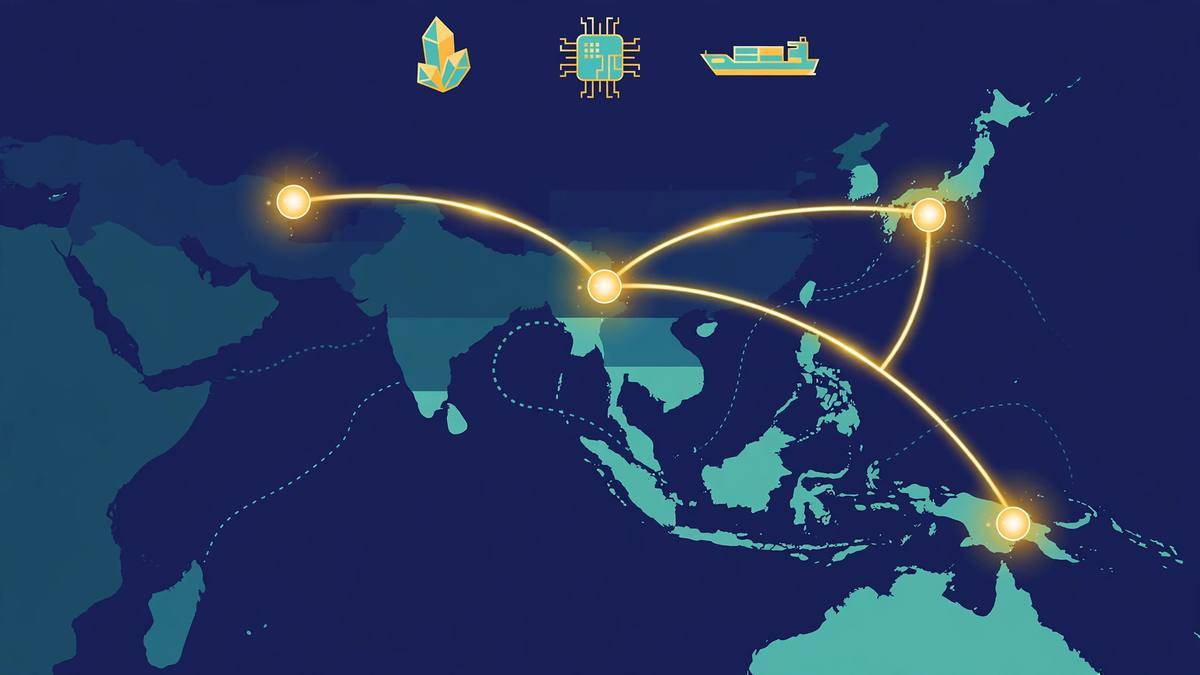
On 17 November 2026, the leaders of India, the United States, Japan and Australia sat down together in Manila for the first in-person Quad summit in two years. It happened on the sidelines of the 49th ASEAN Summit, hosted by the Philippines — and it was not a ceremonial reunion.
Prime Minister Narendra Modi, US President Donald Trump, Japanese Prime Minister Sanae Takaichi and Australian Prime Minister Anthony Albanese came with a concrete agenda: rare earth minerals, artificial intelligence, and maritime security. By the end of the day, they had announced a joint push on all three — including an $85-million Quad investment in an AI accelerator and a new maritime exercise with maritime control drills.
The Quad has spent years being described as a talking shop. Manila was the day it tried to prove otherwise. Here is what actually changed — and why it matters.
1. Rare earths are the new oil — and the Quad wants its own supply
The headline from Manila was not about defence. It was about rocks.
Rare earth elements are the tiny, unglamorous ingredients inside almost everything modern: smartphones, electric vehicles, wind turbines, fighter jets, missile guidance systems. And for decades, one country has dominated their processing — China.
President Trump put the Quad's answer bluntly on the sidelines of the summit: the United States is now producing rare earths "at a level that we've never made before" and will catch up with China "within 10 months". He added that Japan and India are ramping up production too. "Everything that we need, we'll have in 10 months," he said.
That is a bold claim, and the timeline will be tested. Building mines and refineries takes years, not months, and China spent decades building its lead. But the direction is unmistakable: the four countries are no longer just complaining about dependence on a single supplier. They are trying to build an alternative supply chain together — and India, with its own rare earth reserves and processing ambitions, is a central part of that plan.
For ordinary people, this is not abstract geopolitics. Whoever controls rare earths controls the price of phones, EVs and clean energy. A second supply chain means steadier prices and fewer shocks when one country decides to restrict exports.
2. The Quad is becoming a technology alliance, not just a security club
The second announcement from Manila was about AI. Trump announced an $85-million Quad investment in an AI accelerator, aimed at widening access to trusted artificial intelligence across the four countries.
That matters because the Quad started life as a security dialogue — four democracies worried about sea lanes and military balance in the Indo-Pacific. Over time it has quietly become something broader: a group that coordinates on vaccines, undersea cables, critical minerals, and now AI infrastructure.
Modi described the Quad as a "trusted partnership delivering solutions", and said he was confident the Manila meeting would set concrete goals for the next phase of cooperation. He also unveiled a seven-point push to deepen India's ties with ASEAN, stretching from maritime security to critical minerals — a reminder that the Quad's ambitions now reach beyond its four members.
The pattern is clear. The great-power competition of this decade is not only fought with ships and missiles. It is fought over who builds the chips, who trains the AI models, and who writes the standards. The Quad wants a seat at that table as a group, not as four separate countries.
3. Maritime drills: the quiet signal in the room
The third announcement — a joint maritime exercise including maritime control drills — got the least attention, and it may be the most telling.
The Indo-Pacific's sea lanes carry a huge share of world trade, including most of India's oil imports. When four navies practise operating together, they are sending two messages at once: to each other, that the partnership is operational, not just rhetorical; and to everyone else, that these waters are watched.
This is the part of the Quad that has always been the most sensitive, because it sits closest to traditional military cooperation. But note what the summit did not do: it did not announce a military alliance, a joint command, or anything aimed at a single named adversary. The language stayed on cooperation, supply chains and shared security. That restraint is deliberate — and it is what keeps countries like the Philippines and the ASEAN members comfortable hosting the group.
4. The personal chemistry is the point — and the risk
Summits are also theatre, and Manila had its share. Trump called Modi a "tough man" and described the four leaders as "phenomenal people". Modi was photographed picking up a small Indian flag that had been placed as a spot marker during the group photo — a small, human moment that travelled further on social media than any communiqué.
That chemistry is genuinely useful. The Quad has no treaty, no headquarters, no secretary-general. What holds it together is the leaders' willingness to keep showing up. The last in-person leaders' summit was in 2024; the two-year gap was the group's biggest weakness. Manila closed that gap.
But the chemistry is also the risk. A grouping held together by four leaders' personal rapport is only as stable as their politics. Elections, changes of government, or a falling-out between any two members can stall the whole project — as the 2024–2026 pause showed. The real test of Manila is not what was announced, but whether the working groups on minerals, AI and maritime security keep moving when the cameras leave.
5. What to watch next
Three things will tell us whether Manila mattered.
First, the rare earths timeline. If the US, India and Japan announce actual mines, refineries or offtake agreements in the coming months, the 10-month claim has substance. If it stays at the level of speeches, it was a slogan.
Second, the AI accelerator. $85 million is modest by the standards of the AI industry — a single data centre costs far more. Its value will depend on what it actually funds: shared compute, joint research, or standards for trusted AI. Details will matter more than the number.
Third, the calendar. The Quad's credibility depends on regularity. A leaders' summit every year, foreign ministers meeting in between, and working groups that report progress — that is what turns a photo opportunity into an institution.
And the wider context matters too. Just two days after Manila, on 19 November, China has confirmed a first trilateral summit with the US and Russia in Shenzhen. The same week will therefore feature two very different pictures of great-power politics: one of four democracies coordinating, and one of three rivals talking. Asia's map is being redrawn in real time, and Manila was one of the lines being drawn.
The Quad is back. The question now is whether it can stay back — and deliver.
The Quad leaders' summit was held in Manila on 17 November 2026 on the sidelines of the 49th ASEAN Summit. The Quad brings together India, the United States, Japan and Australia. China has confirmed a trilateral summit with the US and Russia in Shenzhen on 19 November 2026.
Like and comment on the interactive version of this post.
← All posts