Trump, Xi and Putin in One Room: What the Shenzhen Trilateral Really Means
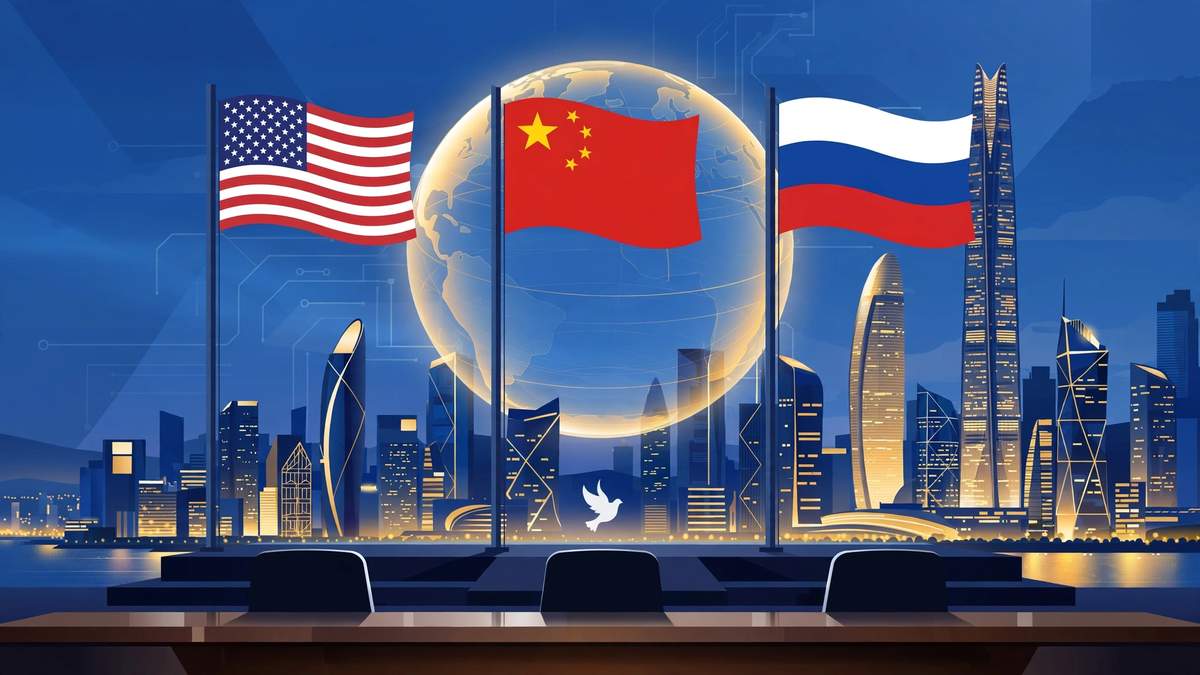
On Thursday, 19 November 2026, three men sat down in the same room in Shenzhen, China. Donald Trump of the United States. Xi Jinping of China. Vladimir Putin of Russia.
It was the first trilateral meeting of the leaders of the world's three great powers — ever. It happened on the sidelines of the 33rd APEC Economic Leaders' Meeting, and it lasted about an hour.
That is the news. The interesting part is what it means — and what it does not.
Why this meeting is genuinely historic
Great-power summits are not new. The famous Yalta Conference of February 1945 brought the US, Britain and the Soviet Union together to shape the post-war world. But a meeting of the leaders of the US, China and Russia — the three countries that hold almost all of the world's nuclear weapons — has never happened before.
The choreography said as much. Xi Jinping personally greeted Trump at the airport on Wednesday, a rare honour. Putin, who arrived earlier, exchanged a public handshake with Trump. Xi and Putin held their own bilateral talks before Trump's plane even landed. Beijing described the gathering as having "groundbreaking significance".
Trump, for his part, called it "historic" and said he looked forward to discussing "more opportunities for all three".
None of that guarantees a result. Analysts and officials quoted across the coverage agree on one thing: expectations of a major breakthrough are low. The meeting is tightly choreographed and largely symbolic. But symbolism, at this level, is itself a signal.
What is actually on the table
Four issues dominate the agenda, and each one is a world problem in its own right.
1. Nuclear arms control. The New START treaty — the last remaining US–Russia nuclear arms limitation agreement — expired in February 2026. There is now no binding limit on the two largest nuclear arsenals on Earth. Trump's stated priority is to bring China and Russia into a new arms control treaty. The numbers explain the difficulty: the US and Russia each hold more than 5,000 warheads, while China holds just over 600. Beijing has long resisted joining US–Russia limits until Washington and Moscow cut their much larger arsenals first. There is also talk of rules for artificial intelligence in nuclear weapons systems — a new frontier where no rules exist at all.
2. The Iran war. The US and Israel launched a war against Iran on 28 February 2026. It is on the agenda in Shenzhen, though what three powers with very different stakes in the region can agree on is an open question.
3. Trade and technology. Tariffs, technology restrictions and global supply chains remain unresolved between the US and China, even after the recent trade deal both sides have been implementing. Access to advanced chips and artificial intelligence is now a core part of great-power competition, not a side issue. Elon Musk, the Tesla and SpaceX chief, was expected to accompany Trump in Shenzhen — a reminder that in 2026, tech billionaires travel with presidents.
4. Ukraine. Here the signals are mixed. Trump said before departing that Ukraine would be discussed — "Ukraine and Russia are losing 25,000 souls per month" — while a US administration official told reporters he did not intend to raise it. Kyiv and European partners are watching nervously: the fear is that three powers could discuss Ukraine's future without Ukraine in the room.
What it means for India
India was not at the table in Shenzhen. But almost everything on the table touches India.
Start with the timing. Just two days earlier, on 17 November, Quad leaders met in Manila and launched new maritime surveillance cooperation. On 18 November, India and the US moved close to a trade deal. India and Canada are eyeing a defence pact during Prime Minister Modi's December visit. India is, in other words, deepening its partnerships in every direction at once — and a US–China–Russia conversation changes the weather for all of them.
If the three powers agree even on a framework for nuclear talks, the world gets safer, and India — a nuclear power that has always argued for disarmament — benefits directly. If trade tensions ease, Indian exporters gain breathing room. If the Iran conflict escalates, oil prices and shipping through the Strait of Hormuz hit India's economy within days.
The deeper lesson is about multipolarity. For decades, the big decisions were made by two superpowers, then by one. Shenzhen suggests a world where three powers negotiate — and where middle powers like India matter more, not less, because no single table can settle anything without them. India's strategy of engaging everyone, and being owned by no one, looks less like hedging and more like foresight.
The honest verdict
One hour cannot end a war, sign a treaty or fix a trade relationship. Nobody in Shenzhen pretended otherwise. The value of this meeting is different: it establishes that the three nuclear powers can still sit in one room and talk.
In a year when the last arms control treaty expired, when a new war began in the Gulf, and when trade became a weapon, that is not nothing. The last time the world had no limits on nuclear arsenals, it built the habit of talking first and counting warheads second. Shenzhen is a small step back toward that habit.
The real test comes next: whether the hour in Shenzhen becomes a negotiating track — or just a photograph. Watch for a joint statement, a follow-up meeting date, and any mention of nuclear talks. If those appear, the meeting mattered. If not, it was still the most important photograph of the year.
The first-ever US–China–Russia trilateral summit took place on 19 November 2026 in Shenzhen, China, on the sidelines of the 33rd APEC Economic Leaders' Meeting. The New START treaty expired in February 2026. The US and Russia each hold more than 5,000 nuclear warheads; China holds just over 600.
Like and comment on the interactive version of this post.
← All posts